The formula: weight, wind and a style multiplier
The kite guides agree on the shape of the answer even where their charts differ in detail: a heavier rider needs more kite area to generate the same pull, and faster wind needs less area, because power rises with wind speed. The published heuristic behind the calculators states it as one division, with a multiplier that carries the riding style — beginners get extra margin, advanced riders trade margin for control, and foil riders need far less kite because the hydrofoil itself generates the lift.
Kite size (m²) = rider weight (kg) × style multiplier ÷ wind speed (knots) — Beginner 2.2, Intermediate twin-tip 2.4, Advanced / directional 2.0, Foilboard 1.5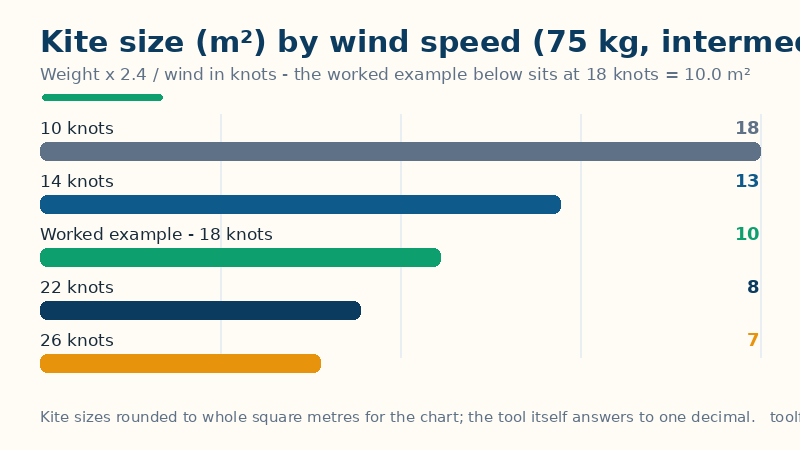
Each symbol is defined, because the formula is only useful if its inputs are: weight is the rider's body weight in kilograms (75 kg is 165 lb); wind is the average wind speed at the spot in knots, the unit every kite chart is written in (1 knot is 1.15078 mph and 1.852 km/h, so 18 knots is 20.7 mph and 33.3 km/h); and the multiplier is the style factor above, from the widely cited heuristic the kite calculators publish. The answer is the ideal kite area in square metres, and kites are sold in whole square metres, so the tool rounds the gust and lull answers to whole sizes for the quiver range.
Worked example: 75 kg, intermediate, 18 knots
A 75 kg (165 lb) intermediate twin-tip rider in 18 knots of wind takes a 10.0 m² kite, with a quiver of 8–14 m². The working: 75 × 2.4 ÷ 18 = 10.0 exactly; gusts 5 knots above average are 23 knots, giving 75 × 2.4 ÷ 23 = 7.8 m², nearest whole kite 8 m²; lulls 5 knots below are 13 knots, giving 75 × 2.4 ÷ 13 = 13.8 m², nearest whole kite 14 m². The board for 75 kg is 140–160 cm, about 43 cm wide, from the published weight bands below. Two more spot checks from the same formula at 18 knots, intermediate: a 60 kg rider takes 8.0 m² (60 × 2.4 ÷ 18) and a 90 kg rider takes 12.0 m² (90 × 2.4 ÷ 18), while a 100 kg rider takes 13.3 m² — the weight effect is linear, so every extra 10 kg at this wind adds about 1.3 m². As a cross-check against an independent published chart: at 18–20 knots the formula gives 10.0–9.0 m² for a 75 kg rider, inside the 9–10 m² band the Airush guide publishes for 70–80 kg riders at 18–22 knots.
The board bands, and why the board matters too
The kite is only half the setup: a bigger board planes earlier and holds up in lighter wind, so the board bands run the other way from the kite — heavier riders and lighter winds both want more board. The published board chart the tool uses is:
| Rider weight | Board length | Board width |
|---|---|---|
| 56–68 kg | 134–148 cm | 41 cm |
| 68–81 kg | 140–160 cm | 43 cm |
| 81–95 kg | 142–165 cm | 45 cm |
| Over 95 kg | 146–165 cm | 46 cm |
Riders under 56 kg sit below this chart's first band and should look at junior and light-rider boards under 134 cm. A rider exactly on a boundary — 68 kg, for example — sits in the 56–68 kg row on this page. Boards run roughly 125–165 cm long and 38–50 cm wide overall, and the same weight logic applies at the margins: lighter wind wants the longer end of your band, stronger wind the shorter end.
How to read your result, and its limits
Three checks before rigging. First, average wind is not the wind you will feel: the quiver range exists because a session swings between gusts and lulls, and a kite chosen for the average alone is overpowered in the gusts and underpowered in the lulls — if you own one kite, pick the size closest to the ideal and accept a narrower usable wind window, roughly 10–12 knots. Second, kite model moves the answer: high-aspect bow kites, hybrids and C-kites of the same nominal size do not pull identically, and the formula cannot know which you own — treat its answer as the centre of a size to try, not a verdict. Third, skill moves the multiplier: the foil multiplier of 1.5 is not a small adjustment — a foil rider at the worked example's weight and wind takes 75 × 1.5 ÷ 18 = 6.3 m², roughly two to four sizes below the twin-tip answer, because the foil generates lift the board does not have to.
Common mistakes
- Choosing for the strongest wind you remember. A kite sized for gusts alone will not get you going in the average wind — size for the average, and let the quiver range cover the swings.
- Buying the biggest kite to ride in light wind. A kite above about 14–17 m² turns slowly, relaunches badly and punishes mistakes — a bigger board is the cheaper, safer way to gain light-wind range.
- Ignoring the board entirely. Two riders of the same weight in the same wind on different boards need different kites; the board band on this page is part of the answer, not decoration.
- Skipping lessons to save money. A wrong first kite costs more than a lesson, and no calculator replaces an instructor watching your first sessions in real wind.
Related tools: Surfboard Size Calculator — Your surfboard size from weight and skill: target volume, board type and length range; Paddleboard Size Calculator — The right stand-up paddleboard from your weight, use and skill: minimum volume, length range and width from one published rule, shown openly; Wakeboard Size Calculator — The right wakeboard length from your weight and ability: the published weight-band chart as a calculator, with the pick inside each band shown.
Frequently asked questions
What size kite do I need for my weight and wind?
Weight in kilograms × a style multiplier ÷ wind in knots: a 75 kg intermediate twin-tip rider in 18 knots takes 75 × 2.4 ÷ 18 = 10.0 m². Enter your own weight, average wind and style above for your size, plus the quiver range for gusts and lulls.
Why does the calculator show a quiver range as well as one size?
Because wind is never steady: the range assumes gusts 5 knots above and lulls 5 knots below your average, so the worked example's 10.0 m² kite sits inside an 8–14 m² quiver. If you own one kite, pick the size closest to the ideal and accept a narrower wind window.
What board size goes with my weight?
From the published weight bands: 56–68 kg takes 134–148 cm (41 cm wide), 68–81 kg takes 140–160 cm (43 cm), 81–95 kg takes 142–165 cm (45 cm), and over 95 kg takes 146–165 cm (46 cm). Lighter wind wants the longer end of your band.
Should I size up or down when I am between kite sizes?
Down, in strong or gusty wind — an overpowered kite is the dangerous mistake, while an underpowered one merely keeps you off the plane. Beginners get extra margin built in (multiplier 2.2), and foil riders need far less kite (multiplier 1.5) because the foil generates the lift.
