Calories first, then weight — never weight first
Two methods circulate for planning backpacking food, and only one of them survives contact with a real menu. The weight method says pack 1.5 to 2.5 lb of food per person per day. It is easy, and it is wrong whenever the food is not average: a pound of fresh fruit carries under 30 calories an ounce, while a pound of nuts carries 150 to 200, so the same weight can feed a person for half a day or for two days. The calorie method — the one this page uses — starts from what the body actually needs, turns those calories into weight through the density of the food packed, and only then talks about pounds. Backpackers commonly cite 2,500 to 3,500 calories a day on a trip, rising toward 4,000 to 5,000 on long, steep or cold days, and a balanced menu averages about 125 calories an ounce. Those two numbers, plus the trip length and the group size, are the whole calculation.
Total calories = trip days × people × calories per person per day × (1 + buffer ÷ 100) — Total food weight (oz) = total calories ÷ calorie density (kcal/oz) — Pounds = ounces ÷ 16 — Kilograms = ounces × 28.3495 ÷ 1,000 — Per person per day (oz) = calories per person per day × (1 + buffer ÷ 100) ÷ calorie density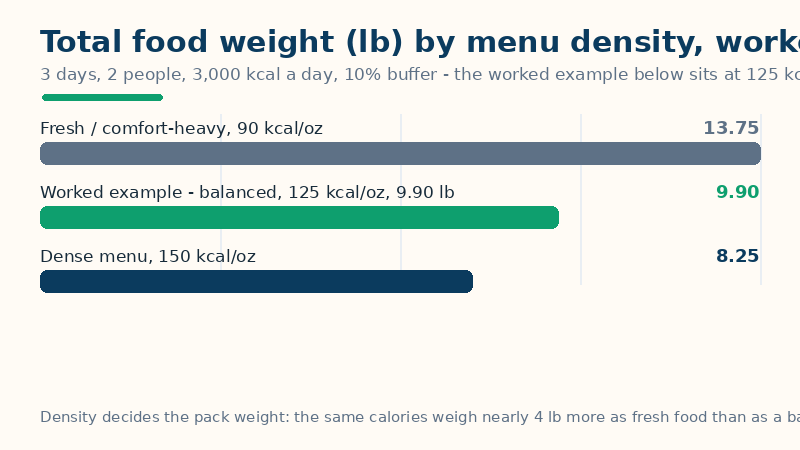
The buffer deserves a sentence of its own. It is not a rounding-up habit: it is the spare day's food that turns a delay from a hunger problem into an inconvenience. Ten percent on a three-day trip is roughly a third of a day's food per person, which is why experienced planners pack a full spare day on any trip where a crossing, a snow line or a missed pickup could hold the group up. The buffer is applied to calories before the weight is worked out, so it scales with the trip instead of being a fixed extra bag.
Worked example: 3 days, 2 people, 3,000 calories a day at 125 kcal/oz, 10% buffer
Two people on a three-day trip eating 3,000 calories each a day, packing balanced food at 125 calories an ounce with a 10% buffer, need 158.4 oz of food — 9.90 lb, 4.49 kg — which is 26.4 oz (1.65 lb, 0.75 kg) per person per day and 79.2 oz (4.95 lb, 2.25 kg) per person for the whole trip. The working: base calories = 3 × 2 × 3,000 = 18,000 kcal. Buffer = 10% of 18,000 = 1,800 kcal. Total = 18,000 + 1,800 = 19,800 kcal. Total weight = 19,800 ÷ 125 = 158.4 oz. Pounds = 158.4 ÷ 16 = 9.90 lb. Kilograms = 158.4 × 28.3495 ÷ 1,000 = 4.49 kg. Per person per day = 3,000 × 1.10 ÷ 125 = 26.4 oz = 1.65 lb. Per person for the trip = 3 × 26.4 = 79.2 oz = 4.95 lb. Every part adds back: 2 people × 79.2 oz = 158.4 oz, and 3 days × 26.4 oz = 79.2 oz. The same trip at other densities shows why density, not appetite, decides the pack weight:
| Food density | Total weight for this trip | Per person per day |
|---|---|---|
| 90 kcal/oz (fresh / comfort-heavy) | 220.0 oz / 13.75 lb / 6.24 kg | 36.7 oz / 2.29 lb |
| 125 kcal/oz (balanced, worked example) | 158.4 oz / 9.90 lb / 4.49 kg | 26.4 oz / 1.65 lb |
| 150 kcal/oz (dense ultralight menu) | 132.0 oz / 8.25 lb / 3.74 kg | 22.0 oz / 1.38 lb |
Check the dense row by hand: 19,800 ÷ 150 = 132.0 oz, and 132.0 ÷ 16 = 8.25 lb. And check the fresh row: 19,800 ÷ 90 = 220.0 oz, which is 13.75 lb — nearly 4 lb more than the balanced menu for exactly the same calories. Effort moves the daily figure the same way, at the worked density and buffer:
| Day's effort | Calories per person | Food per person that day |
|---|---|---|
| Easy walking, warm weather | 2,500 kcal | 22.0 oz / 1.38 lb |
| Full days with a pack (worked example) | 3,000 kcal | 26.4 oz / 1.65 lb |
| Long miles, big climbs | 4,000 kcal | 35.2 oz / 2.20 lb |
| Long miles in the cold | 5,000 kcal | 44.0 oz / 2.75 lb |
Check the cold row: 5,000 × 1.10 ÷ 125 = 44.0 oz, and 44.0 ÷ 16 = 2.75 lb — above the top of the usual 1.5 to 2.5 lb range, which is the point: the range assumes moderate days and average food, and a hard cold day is neither.
How to read your result, and its limits
Three checks before trusting the figure. First, the density you enter decides the answer: if you do not know your menu's density, weigh a day's food and count its calories once at home — that single measurement beats any published average, because your menu is the one being carried. Second, this page counts food only: water, which weighs a kilogram a litre and changes through the day, is planned separately, and fuel sits in the backpack weight calculator's consumables, not here. Third, calorie needs are individual: a smaller hiker on an easy day needs far less than a larger hiker on a hard cold day, so a group figure is a starting point — adjust the calories per person for the people actually walking, and keep the buffer for the delay, not for the appetite.
Common mistakes
- Packing by weight instead of by calories. A pound of fresh food and a pound of nuts are not the same amount of food — plan calories first, then convert at your menu's density.
- Using the 1.5 to 2.5 lb range with heavy food. The range only works at roughly 125 calories an ounce; at 90 the same calories weigh nearly 40% more.
- Forgetting the buffer, then rationing on the last day. A delay is the commonest reason trips run short — the buffer is the cheapest weight in the pack.
- Counting water in the food weight. Water is planned by the hour and the refill, not by the trip — mixing it into food weight double-counts what you drink and refill.
Related tools: Backpack Weight Calculator — Your pack weight from gear, food, water and fuel — base weight, total pack weight and load as a percentage of body weight, with the weight bands shown; Hiking Water Calculator — Your hiking water from hours, heat and effort — litres to carry, 1-litre bottles and the pack weight, with a delay hour and camp water included; Camp Stove Fuel Calculator — Your camp stove fuel from group, days and stove type — grams and whole canisters for canister stoves, fluid ounces for white gas, cold and wind included.
Frequently asked questions
How much food should I pack per person per day backpacking?
The commonly cited range is 1.5 to 2.5 lb per person per day, but only at roughly 125 calories an ounce. The accurate method is calories first: 2,500 to 3,500 calories a day for most backpackers, divided by your menu's density — at 125 kcal/oz with a 10% buffer, 3,000 calories is 26.4 oz (1.65 lb) a day.
What is a good calorie density for backpacking food?
Balanced backpacking food averages about 125 calories an ounce. Dense food — nuts, cheese, nut butter, olive oil — runs 150 or more, while fresh or comfort-heavy food drops to about 90. The same calories weigh 220.0 oz at 90 kcal/oz but only 132.0 oz at 150, so density decides the pack weight.
Does the camping food calculator include water?
No — food only. Water weighs 1 kg a litre and changes through the day as you drink and refill, so it is planned separately by the hour, not by the trip. Use the hiking water calculator for water and keep food weight free of it.
How much extra food should I pack as a safety buffer?
Ten percent is a reasonable default, and a full spare day's food is the classic rule on any trip where a river crossing, a snow line or a missed pickup could hold you up. The buffer is insurance against delay, not extra eating — it is the cheapest weight in the pack when the delay actually happens.
