Two ways of pricing a move: by the hour, or by the pound
The whole calculation is one multiplication either way, and the move type is the one people get wrong. A local move under 100 miles is billed by the hour — crew size times hours times the hourly rate, plus a flat truck fee. A long-distance move of 100 miles or more is billed by the weight of the shipment — pounds times the rate per pound, plus a mileage charge — and the weight is the number that drives the price, which is why the carrier weighs the shipment rather than taking your word for it. Packing, specialty items and storage are added as their own lines, and peak season adds 25% to the mover's base charge:
local move ($) = movers × hours × hourly rate + truck fee + extras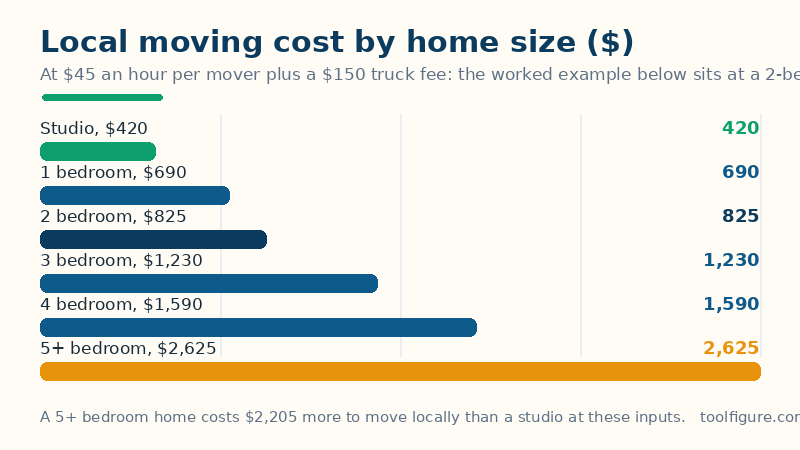
long-distance move ($) = weight (lbs) × rate per pound + distance (miles) × rate per mile + extraspeak season (May–September) = base charge × 1.25If you only know the volume, movers convert it at about 7 pounds per cubic foot: a load of 800 cubic feet is roughly 5,600 pounds, and a 2-bedroom home at 5,000 pounds is about 714 cubic feet. The table above shows the long-distance maths at 1,000 miles and $0.60 a pound plus $0.50 a mile: a studio at 2,000 lbs costs $1,200 of weight charge and $1,700.00 in total, a 1-bedroom at 3,500 lbs costs $2,100 and $2,600.00, the worked example's 2-bedroom at 5,000 lbs costs $3,000 and $3,500.00, a 3-bedroom at 7,500 lbs costs $4,500 and $5,000.00, a 4-bedroom at 10,000 lbs costs $6,000 and $6,500.00, and a 5+ bedroom home at 13,000 lbs costs $7,800 and $8,300.00. The local maths at $45 an hour per mover plus a $150 truck fee is: a studio with 2 movers for 3 hours costs $270 of labour and $420.00 in total, a 1-bedroom with 3 movers for 4 hours costs $540 and $690.00, a 2-bedroom with 3 movers for 5 hours costs $675 and $825.00, a 3-bedroom with 4 movers for 6 hours costs $1,080.00 and $1,230.00, a 4-bedroom with 4 movers for 8 hours costs $1,440.00 and $1,590.00, and a 5+ bedroom home with 5 movers for 11 hours costs $2,475.00 and $2,625.00.
Worked example: a 2-bedroom home, 1,000 miles
A 2-bedroom home ships at 5,000 lbs over 1,000 miles at $0.60 a pound and $0.50 a mile. The weight charge is 5,000 × $0.60 = $3,000.00, the mileage charge is 1,000 × $0.50 = $500.00, and the move costs $3,000.00 + $500.00 = $3,500.00 — $0.70 a pound all-in and $3.50 a mile. The same home moved locally — 3 movers, 5 hours at $45 an hour plus a $150 truck fee — would cost 3 × 5 × $45 = $675.00 of labour plus $150.00, or $825.00, which is $275.00 per mover for the day. In peak season the long-distance move would be $3,500.00 × 1.25 = $4,375.00, and the local move $825.00 × 1.25 = $1,031.25. Six published cross-checks reproduce: Allied Van Lines, citing industry data, puts the average at about $4,300 to move a 7,400-pound household more than 1,000 miles — at $0.58 a pound with no separate mileage charge this page gives $4,292.00, the same figure to within the rounding of their "about". A 1-bedroom home moved 500 miles costs $2,350.00 on this page — inside MoveCostCalc's $1,200–$2,800 range for that move, whose median is $1,890. A 2-bedroom home moved 750 miles costs $3,375.00 and a 3-bedroom $4,875.00 — both inside Book My Move's $3,060–$5,280 range for a 2–3 bedroom move of 500–1,000 miles. The worked example's $3,500.00 sits inside Coastal Moving Services' $3,200–$5,200 range for a 2-bedroom home moved 1,000–2,000 miles, inside Miniwebtool's $2,500–$5,000 range for a 2-bedroom long-distance move, and a studio at 1,000 miles costs $1,700.00 on this page — inside Agoyu's $1,200–$3,000 range and Miniwebtool's $1,200–$2,500 range for a studio. And the local figures sit inside the published bands too: Miniwebtool puts a 2-bedroom local move at $800–$1,800, and this page's $825.00 is inside it, while MoveCostCalc's median for a 2-bedroom local move is $960 on a $650–$1,400 range.
How to read your result, and its limits
Four cautions keep the number honest. First, the weight is an estimate: the carrier weighs the shipment, and the weighed figure decides the final bill — a home that looks like 5,000 lbs can weigh 6,000 once the books, the tools and the garage are counted, and at $0.60 a pound that is $600 more. Second, this is the mover's charge, not the whole move: packing service typically adds $500–$2,000, storage between homes is a separate line, and access — stairs, a long carry from the truck, a shuttle for a narrow street — adds fees the estimate does not include. Third, peak season is real money: the industry's peak runs May through September, when demand and prices spike by 20–30%, so the same 2-bedroom move that costs $3,500.00 off-peak costs $4,375.00 in peak season on this page's 25% uplift — moving in October to April is the cheapest single choice you can make. Fourth, binding and non-binding estimates are different promises: under federal rules for interstate household goods moves, a mover can require you to pay no more than 110 percent of a non-binding estimate at delivery, with up to 30 days to pay the rest — so a non-binding $3,500.00 estimate can become $3,850.00 at the door, while a binding estimate locks the price as long as the inventory does not change. A do-it-yourself move is the comparison worth making: a truck rental for a local move typically runs $150–$400 before fuel, and a moving container locally $400–$700 — cheaper than the $825.00 local move above, but the labour, the driving and the risk are yours. For the drive itself, the fuel cost calculator prices the trip's fuel by miles, MPG and pump price; for the size of the place you are moving into, the square footage calculator measures it from your real dimensions.
Common mistakes
- Pricing a long-distance move by the hour. Long-distance carriers price by weight, not by time: a 5,000-lb shipment at $0.60 a pound is $3,000.00 of weight charge before the mileage, however fast the truck drives. The hourly formula belongs to local moves only.
- Using cubic feet as pounds. Volume and weight are different numbers — movers convert at about 7 pounds per cubic foot, so an 800-cubic-foot load is roughly 5,600 lbs, not 800 lbs. Entering the volume as the weight understates the bill by seven times.
- Forgetting peak season. The same 2-bedroom move costs $3,500.00 off-peak and $4,375.00 in peak season on this page's 25% uplift. A May–September move priced at the off-peak figure is $875.00 short.
- Comparing a binding estimate with a non-binding one as if they were the same. A non-binding $3,500.00 estimate can legally become $3,850.00 at delivery under the 110% rule, while a binding estimate locks the price — the two numbers answer different questions.
- Leaving packing, storage and access out of the comparison. Full packing service typically adds $500–$2,000, and stairs, a long carry or a shuttle add fees on top — a quote that omits them is not the cheaper quote, it is the incomplete one.
Related tools: Concrete Calculator — Concrete volume in cubic yards and metres, premix bag counts and ready-mix cost — waste allowance included.
Frequently asked questions
How much does it cost to move locally?
A 2-bedroom local move costs $825.00 at the worked example's inputs — 3 movers, 5 hours at $45 an hour plus a $150 truck fee. Typical ranges put a 2-bedroom local move at $800–$1,800, a studio at $400–$800 and a 3-bedroom at $1,200–$2,800. Full packing service typically adds $500–$2,000.
How much does a long-distance move cost?
A 2-bedroom home moved 1,000 miles costs $3,500.00 at the worked example's inputs — 5,000 lbs at $0.60 a pound plus 1,000 miles at $0.50 a mile. Published ranges put a 2–3 bedroom move of 500–1,000 miles at $3,060–$5,280, and a 2–3 bedroom move over 1,000 miles commonly averages about $4,300.
How is a long-distance move priced?
By the weight of the shipment: pounds times the rate per pound, plus a mileage charge. Allied Van Lines cites about $4,300 to move a 7,400-pound household more than 1,000 miles — roughly $0.58 a pound. If you only know the volume, movers convert at about 7 pounds per cubic foot.
When is the cheapest time to move?
Off-peak, October to April. The moving industry's peak season runs May through September, when demand and prices spike by 20–30% — this page applies 25% to the mover's base charge, so the same 2-bedroom move costs $3,500.00 off-peak and $4,375.00 in peak season. A weekday move is usually cheaper than a weekend one, for the same reason.